Neural circuits for visual behavior
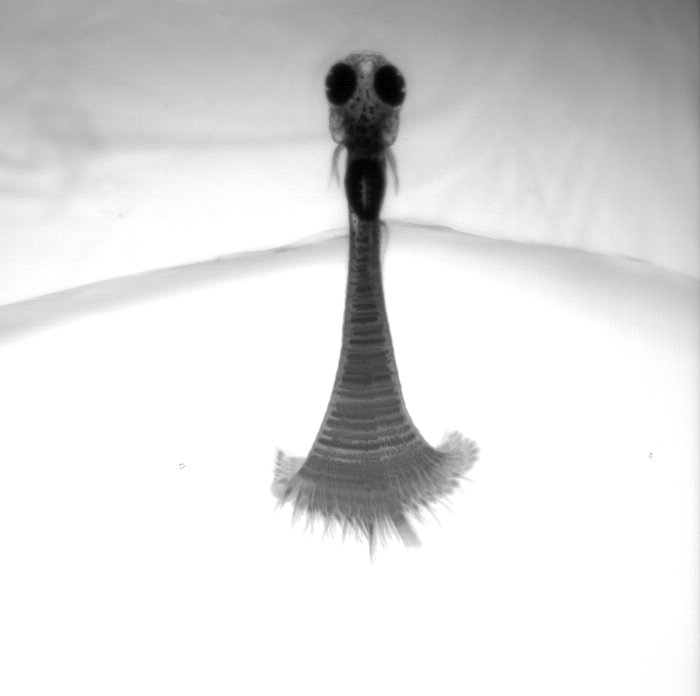
A fundamental question in visual neuroscience, and in neuroscience generally, is how sensory information is represented within the brain and transformed into a behavioral response. In order for an animal to respond to a visual stimulus, the pattern of photons falling on the retina must be classified as a particular type of stimulus, and the brain must generate a spatially appropriate behavior, e.g. toward or away from the stimulus.
The goal of my research is to understand how neurons at different levels of the visual system represent the key features of the stimulus, and how this information is read out and transformed into a motor command.
Techniques
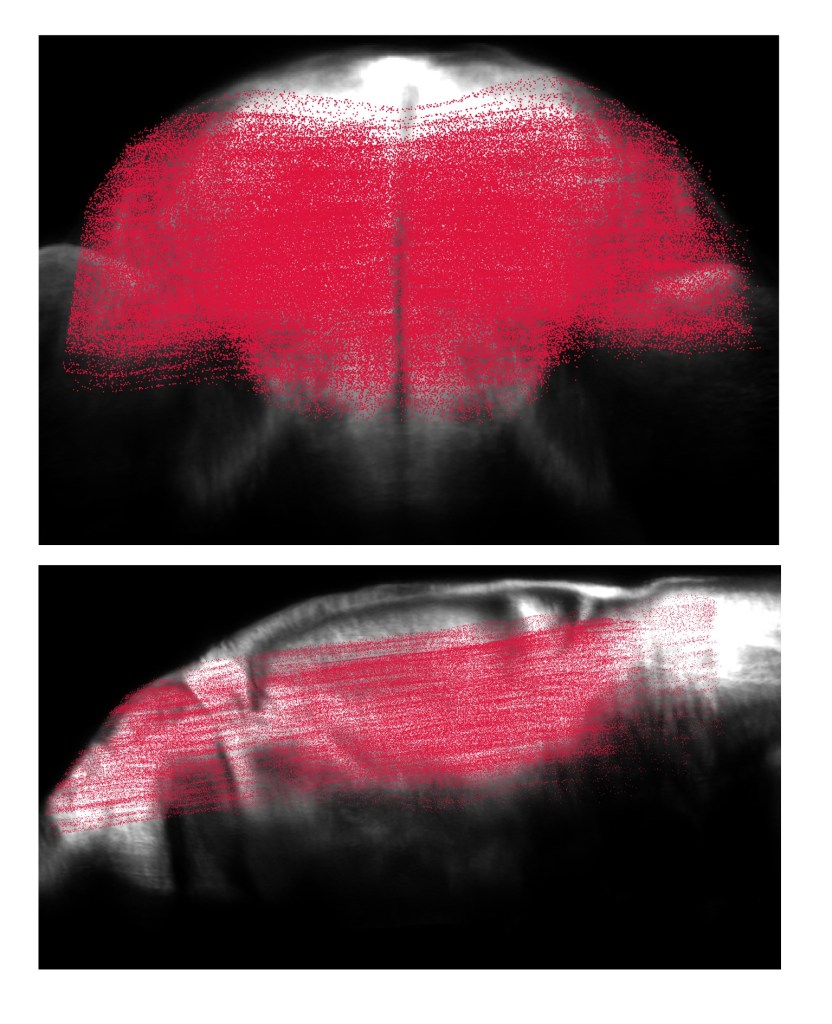
We use 2-photon imaging with an electrically tunable lens to record from a large volume of the zebrafish brain while presenting visual stimuli and recording behavior. This allows us to record the activity of individual neurons and analyse the populations of neurons that are activated by particular stimuli or during visual behaviors.
We also use holographic 2-photon optogenetics to selectively manipulate groups of neurons and asses their impact on function and behavior.
The prey capture strike
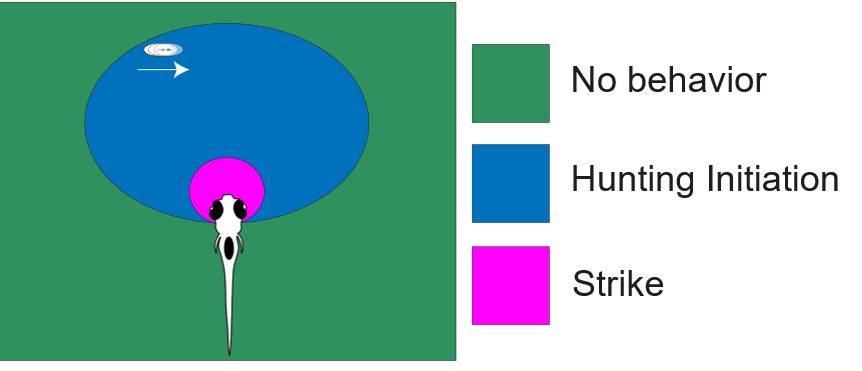
When zebrafish larvae detect a small moving prey object, they converge their eyes and begin to turn toward and approach the prey. Then, when they are close to the prey, they execute the final phase of prey capture, the strike, and suck the prey into their mouths. We developed a head-fixed strike assay to study the cues that larvae use to estimate distance to prey. We found that stimulus contrast is a key factor in determining whether larvae strike, and could be used as a distance cue. We are now using functional imaging to identify the neurons that respond to the stimuli that evoke strikes, to better understand the neuronal basis for distance estimation.
Visually evoked defensive behaviors

Avoiding predators is a key task of the nervous system, and animals have evolved a conserved set of defensive behaviors to respond to potential threats. In many animals, a dark looming visual stimulus evokes escape, and a sweeping stimulus of constant size causes freezing. We found that zebrafish larvae freeze in response to a sweeping stimulus, and we are using volumetric two photon imaging to identify the neurons that respond to the stimulus and those that are correlated with the behavior. Future experiments will focus on how the freezing response can suppress other behaviors such as prey capture, and how larvae decide to escape or freeze in response to a potential predator.
 Semmelhack Lab